Sites
This page acts as the central registry for all network sites managed within the currently selected Tenant. It allows you to monitor the operational status of your sites, access their dashboards, and extract inventory data.
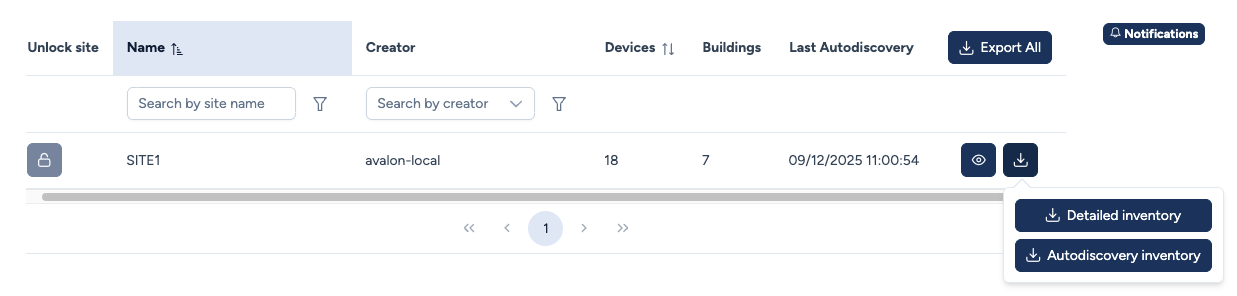
Site List details
The table provides a summary of each site's footprint:
- Unlock site (Lock icon): Indicates the operational status. If a lock appears, a process is currently running (see Handling Locked Sites below).
- Name: The unique identifier of the site.
- Creator: The user who originally created the site.
- Devices: The total number of network assets managed in this site.
- Buildings: The number of physical locations defined.
- Last Autodiscovery: The timestamp of the last successful synchronization.
Filtering: You can use the Search bars at the top of each column to filter the list by site name, creator, or other criteria.
Actions
Global Actions:
- Export All: Downloads a consolidated CSV containing the inventory of all sites listed in the table.
- Note: This file includes an additional "Site" column to distinguish assets across your infrastructure.
Row Actions (Per Site):
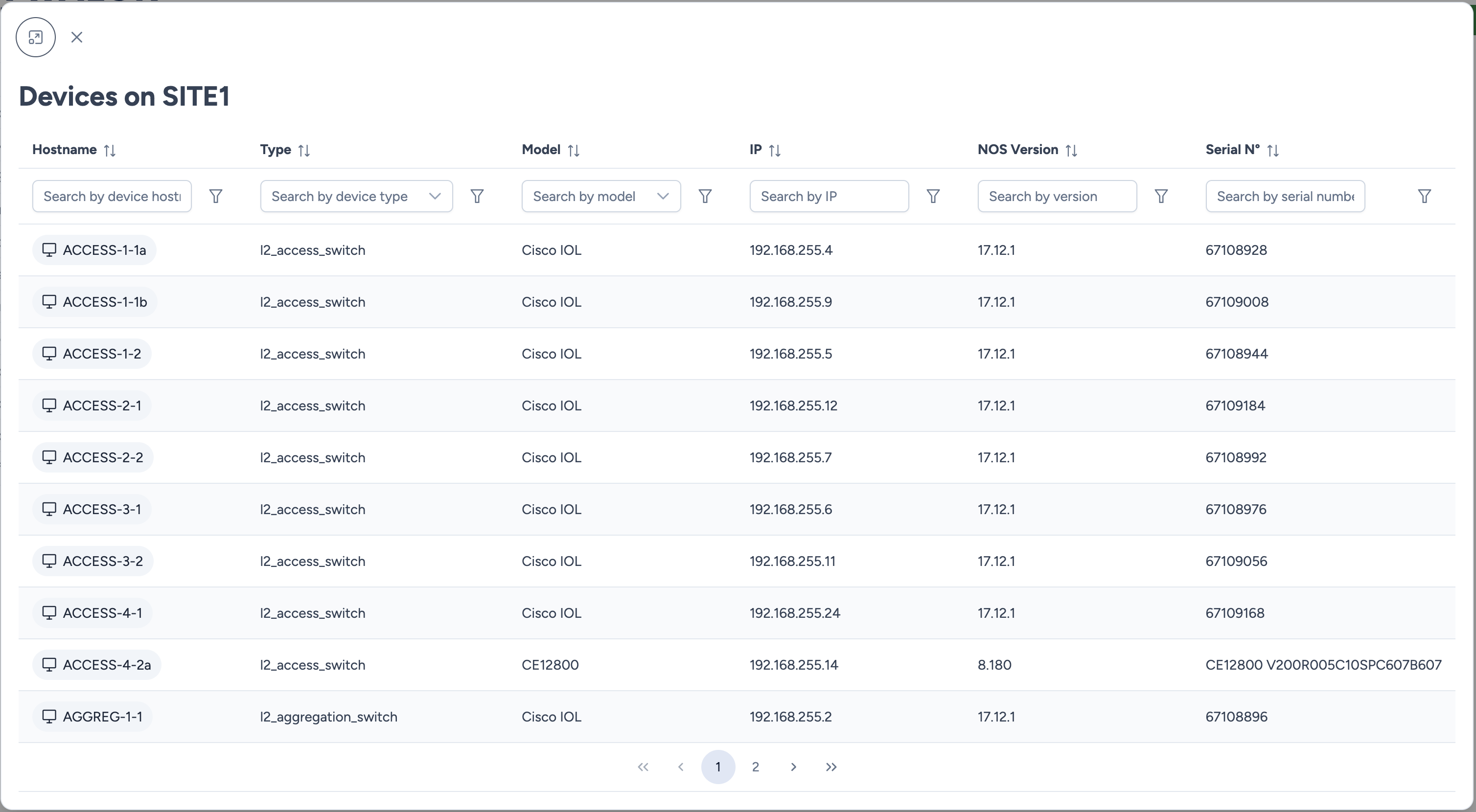
- View (Eye icon): Opens the Site Dashboard / Device List.
- This allows you to drill down into the specific inventory of the site, view detailed asset properties, and access the topology map.
- Export (Download icon): Opens a dropdown menu (as shown in the first image) with two formats:
- Detailed inventory: Generates a comprehensive CSV containing operational data (Versions, Serials, IP addresses, etc.)—ideal for reporting.
- Autodiscovery inventory: Generates a CSV formatted specifically for the AutoDiscovery engine. You can use this file to re-import or backup your target list.
Handling Locked Sites
Avalon implements a locking mechanism to ensure data integrity during critical operations.
Why is a site locked?
When an AutoDiscovery process is running, the site is automatically locked. This is a safety measure to prevent:
- Concurrent Processes: Launching a second discovery while one is already active.
- Data Corruption: Modifying the map (e.g., moving devices) while the engine is updating the topology.
- Consequence: The "Edit" mode (pencil icon) inside the site view is disabled while the lock is active.
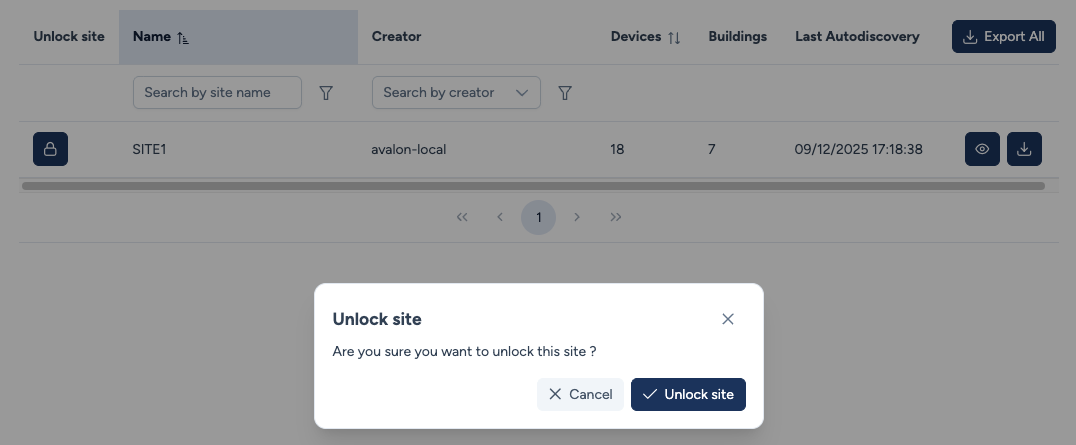
Force Unlock:
Under normal circumstances, the lock disappears automatically once the discovery finishes. However, if an unexpected error occurs during the process (e.g., server crash), the site may remain stuck in a locked state.
- Action: Click the Lock icon in the first column.
- Result: This manually releases the lock, restoring access to the AutoDiscovery launcher and map editing tools.
Use with caution
Only use the Force Unlock feature if you are certain that no background process is currently running (e.g., if the lock has persisted for an abnormally long time without progress).